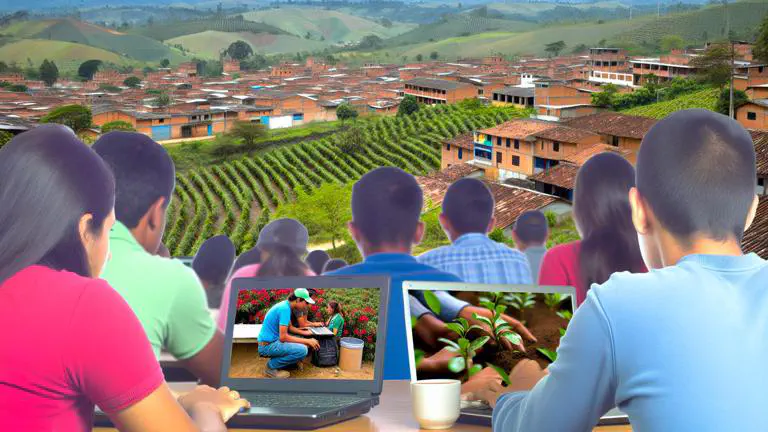
Virtual courses on cardamom cultivation in Colombia
Digital training is a strategic tool for those starting out in cardamom production. The virtual courses on cardamom cultivation in Colombia are designed to turn technical knowledge into concrete actions on the farm: from how to establish a quality nursery to the market conditions that enable marketing and sales and export of production. These programmes combine theory, practical demonstrations and digital tools for smallholder producers and agro-export entrepreneurs.
Why choose a virtual course if you are a new farmer?
- Accessibility: virtual training provides access to specialised content without the need to travel long distances, making it easier for smallholder producers to participate.
- Step-by-step learning: many programmes offer modules on propagation by rhizomes, plantation establishment, nursery management and digitalisation of field records.
- Practical and applied approach: the training combines theory with exercises so that participants can apply what they learn on their plot and generate records useful for certifications and marketing and sales.
Essential content to look for in the courses
An effective virtual course on cardamom includes, at a minimum, the following modules:
- Introduction and context of cardamom cultivation in Colombia
- Brief history and market opportunities observed for Colombian producers.
- Ecological zoning and basic requirements
- Climatic and soil requirements needed for successful crop establishment.
- Propagation and nursery management
- Techniques for producing healthy plants from rhizomes and initial care in seedbeds.
- Field crop management
- Planting, shade and microclimate management, weed control, pruning, and fertilisation.
- Sanitary and pest management
- Monitoring and integrated pest and disease management, with emphasis on biological solutions and cultural practices.
- Harvest and processing
- Collection methods, drying and post-harvest management to preserve pod quality.
- Marketing and sales and export
- Market requirements, traceability, standards and sales channels for marketing and selling cardamom from Colombia.
- Digitalisation and record-keeping
- Tools for maintaining records, work calendars, and input control to facilitate certifications.
- Business plan and market access
- How to structure costs, consider establishment investments and explore clients in international markets.
This content forms the basis for programmes such as cardamom cultivation courses, online cardamom cultivation courses and cardamom course programmes for producers in Colombia, which are now offered in virtual format.
Methodology and teaching resources in virtual training
The best training programmes combine:
- Recorded classes and live sessions for resolving queries.
- Downloadable technical guides and practical handbooks for the farm.
- Application exercises (establishment plan, cost calculations, sanitary records).
- Forums and tutoring with technicians familiar with local challenges.
- Use of applications and spreadsheets to digitalise the mother stock bank, inventories and work calendars.
Digitalising the mother stock bank and recording treatments from the outset facilitate traceability and the possibility of accessing certifications further down the line.
Pest and disease management (what the courses teach)
Sanitary management is one of the key modules in any virtual course on cardamom crop management and export in Latin America. Reference materials recommend prioritising integrated management, combining cultural practices with approved bio-inputs, especially when production targets special or certified markets. Documented recommendations include:
- Sanitary pruning and removal of host weeds to reduce pest populations.
- Use of entomopathogenic agents and biofungicides (for example, Beauveria, Trichoderma) and oils or plant extracts approved under organic standards.
- Residue monitoring to avoid rejections at the border when exporting; observing application intervals and the requirements of certification schemes.
These same approaches are carried over into the structure of the virtual courses, which teach producers to plan monitoring calendars and document interventions in order to meet phytosanitary requirements.
Marketing and sales and international markets: what the courses teach
Online cardamom cultivation courses include marketing and sales modules that explain:
- How to identify export markets and adjust production to quality and traceability requirements. Studies identify relevant destinations and demand dynamics worth knowing when planning entry into foreign markets.
- Packaging, classification and standard requirements that determine the price of the pod in high-value markets.
- Strategies for building associations and collaborative chains to consolidate volumes and reduce logistics costs; association and cooperation are highlighted as tools for accessing better markets.
In addition, local experiences have identified specific demand from countries such as Canada and Middle Eastern markets, confirming the commercial opportunity when quality and traceability are guaranteed.
Establishment costs and financial considerations (based on local references)
Several documents and records from local projects indicate that establishing a plantation requires an initial investment that includes nursery plant production, installation, inputs and labour. Recorded experiences cite figures and economic challenges that are addressed in the business plan and cost calculation module of the courses. This helps producers make informed decisions about the scale of investment, scaling up and risks.
The practical courses teach how to:
- Calculate costs per hectare and per production cycle.
- Estimate return times and sales scenarios.
- Plan investments in nurseries, labour and basic equipment.
Certifications, added value and access to premium markets
Virtual training also provides guidance on certifications that increase the value of production: organic standards, fair trade labels and other schemes requiring traceability and compliance with sustainable practices. The courses show the steps for starting records from the first year to facilitate certification processes later on.
The programmes include practical recommendations for generating added value and attracting international clients seeking cardamom with documented sanitary and environmental conditions.
Modalities and formats: what to choose according to your profile?
- Synchronous virtual courses: with live sessions and tutoring to resolve technical queries.
- Asynchronous courses: recorded lessons and downloadable materials for those needing flexible scheduling.
- Blended programmes: a combination of virtual classes and field practice, useful for smallholder producers who require technical support on the farm.
Programmes designed for smallholder producers and agro-export entrepreneurs typically include business plan templates, sanitary checklists and guides for meeting export requirements.
Example learning plan for a virtual course (suggested modules)
- Fundamentals of cardamom and its potential in Colombia (markets, opportunities).
- Site, soil and microclimate selection.
- Propagation and nurseries: establishing the mother plant and multiplication by rhizomes.
- Agronomic management: planting, fertilisation and pruning.
- Integrated pest and disease management (emphasis on bio-inputs).
- Harvest, drying and quality for markets.
- Marketing and sales, logistics and phytosanitary requirements for export.
- Digitalisation, traceability and preparation for certifications.
- Practical workshop: building the farm plan and budget.
Concrete benefits for new farmers
- Reduced technical risk by applying good practices from the outset.
- Ability to document production and access markets that require traceability.
- Improved economic decision-making through knowledge of real establishment and management costs.
- Tools for forming associations and consolidating sales volumes in international markets.
Recommendations for choosing a good virtual course
- Verify that the programme includes practical modules and downloadable materials (guides, checklists).
- Confirm that the tutors have experience in cardamom production and marketing and sales within the Colombian context.
- Make sure the course covers integrated pest management with biological alternatives and cultural practices, especially if you are considering certified markets.
- Look for training that includes a module on international marketing and sales and export requirements.
- Prefer programmes that teach how to digitalise records from the first year to facilitate certifications and traceability.
Stories and real context: experiences in Colombia
Records from local projects show commercial interest from markets such as Canada and contacts with international buyers, which makes training a way of turning experience into real commercial opportunities. However, reports also point to challenges: the need for trained labour, the initial investment and the willingness to undergo technical support in order to achieve productive and marketable plantations. These aspects are often addressed as content in virtual courses for new farmers.
Additional frequently asked questions (brief answers based on documents)
- Do the courses teach how to export? Yes: many programmes include modules on export requirements, traceability and marketing and sales for international markets.
- Are certifications covered? Yes: the courses advise starting records from the first year and describe the steps for accessing certifications such as organic or sustainability labels.
- Is the use of bio-inputs addressed? Yes: the use of biofungicides and entomopathogens (Beauveria, Trichoderma, neem) and cultural techniques to minimise residues is promoted.
Conclusion and next step
For a new farmer, digital training represents an investment in knowledge that reduces technical uncertainty and improves the ability to access higher-value markets. The virtual courses on cardamom cultivation in Colombia offer a structured path to learning propagation, agronomic management, sanitary control, processing and strategies for marketing, sales and export. Relying on practical content, experienced tutors and tools for documenting production will increase the chances of success for your production project.
Enrol in the virtual course today.
What is the main question you have about starting a cardamom crop, and how would you like a virtual course to support you throughout that process?
About the author
Juan Pablo Toro López is an Agro-industrial Engineer (Universidad La Gran Colombia) with more than 15 years of experience in the food production chain: production, food safety, process standardisation and export requirements. He has been an agro-industry lecturer at SENA and at universities such as Universidad Andina and Fundación Universitaria San Martín, and a digital marketing and sales consultant for companies in the sector.