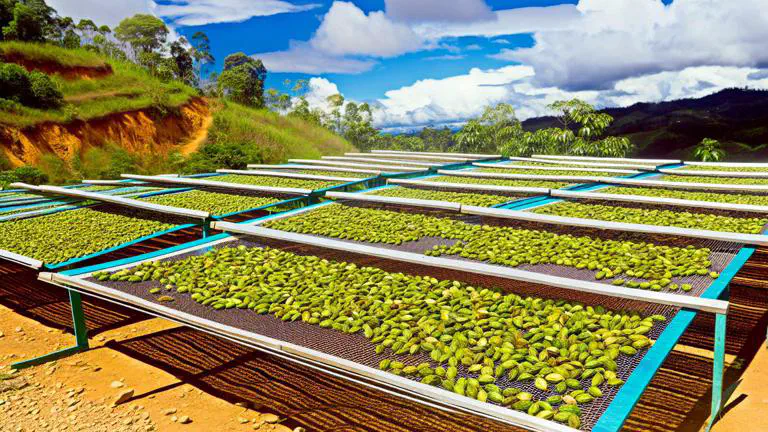
How to safely sun-dry cardamom
IMPORTANT NOTE: FUNDAMENTAL CLARIFICATION REGARDING CARDAMOM DRYING It is crucial that producers understand that optimal, professional drying of freshly harvested green cardamom is achieved solely through the implementation of controlled and constant drying times, relative humidity and temperatures (usually in mechanical dryers). Direct sun exposure negatively affects the colour, aroma and flavour of the final product. The direct sun-exposure drying methodology described in this article is presented as a POSSIBLE, but SUB-OPTIMAL, option for those producers located exclusively in areas where temperature and solar radiation are naturally very high. We strongly recommend that this method be considered only if the final destination of the product is the extraction of dried seed for decorticated marketing and sales. The application of this method is the sole responsibility of the reader.
Sun drying of cardamom is an accessible and sustainable alternative for many farms and cooperatives in Colombia seeking to process Colombian green cardamom at low energy cost. This practical guide, aimed at farmers, describes in detail sustainable post-harvest processes to achieve cardamom sun drying that preserves quality, reduces contamination risks and facilitates the marketing and sales and export of your product.
Throughout the article, technical aspects of post-harvest processing of cardamom for sun drying are integrated, along with quality criteria, controls to be carried out on the farm, and relevant commercial and regulatory considerations for exporting cardamom from Colombia. Where applicable, technical sources and practical guides available to support local implementation are cited .
1. Why choose sun drying: advantages and limitations
Advantages of cardamom sun drying:
- Economic accessibility: lower investment in energy compared to mechanical dryers. This is especially relevant for small and medium-sized Colombian cardamom operations and cooperatives that require cost-effective processes for cardamom marketing and sales.
- Sustainability: the use of renewable energy (sun) reduces the energy footprint of cardamom post-harvest processing.
- Operational simplicity: with proper bed design and management, product of acceptable quality can be obtained for local markets and, with additional controls, for certain international markets .
Limitations and risks:
- Climate dependency: sun drying is sensitive to variations in radiation and humidity, requiring planning during dry seasons and shelter solutions for rainy days.
- Control of temperature and drying rate: drying that is too fast or at high temperatures can cause discolouration and loss of quality; conversely, drying that is too slow increases the risk of mould or fermentation. Studies and practical guides recommend controlling the drying curve to avoid these problems .
Before implementation, it is recommended to assess technical and economic feasibility in your area, taking into account harvest cycles and periods of higher solar radiation to minimise process interruptions .
2. Prerequisites: harvest and selection for sun drying
Drying quality begins at harvest. For effective cardamom sun drying, harvest and selection practices must be followed to minimise defects and losses:
- Manual harvest in cycles: the technical handbook indicates that pods should be hand-harvested when they change from green to greenish-yellow and detach easily; harvests are carried out in cycles of 35 to 40 days depending on the region and age of the crop, which facilitates more uniform management of post-harvest drying .
- Selection by ripeness: separate immature or overripe pods before drying. A high percentage of correctly ripe pods favours yield and quality in the dried product .
- Initial cleaning: remove soil residues, leaves or other foreign materials before placing the pods on the drying beds; the handbook recommends cleaning with fine mesh or sieves to remove foreign material after the initial drying .
These practices improve the quality of dried cardamom and facilitate subsequent classification into commercial grades (for example: extra, fancy, superior) that determine markets and prices for Colombian cardamom both domestically and internationally .
3. Design and set-up of sun-drying beds
For safe and controlled cardamom sun drying, it is recommended to design raised, protected beds:
- Raised beds: place the pods on raised beds or tables covered with fine mesh to allow air circulation underneath and avoid direct contact with the ground. This reduces soil contamination and facilitates more uniform airflow.
- Removable transparent covers: on days with good radiation, use transparent plastic covers that increase temperature and speed up drying; these covers must be quickly removable to ventilate and avoid overheating or condensation that could encourage mould.
- Net surface area and thin layers: spread the pods in thin layers (2–4 cm) to allow uniform drying; layers that are too thick prevent moisture loss and prolong the process, while layers that are too thin increase the risk of localised over-drying.
These practical configurations are recommended in post-harvest processing guides and have been shown to promote drying uniformity when exposure times to the sun and subsequent ventilation are properly managed .
4. Managing the drying curve: temperatures, times and target moisture
A critical technical component is following the drying curve: a rapid initial phase (loss of surface moisture) and a slow falling-rate phase (loss of bound moisture). For cardamom sun drying, practical documents recommend careful management of temperature and duration to preserve colour and aroma:
- Initial phase (rapid onset): during the first hours, surface moisture is reduced rapidly. Reviewed technical guides indicate approximate times of 4–6 hours for the controlled initial phase and temperatures that, in controlled drying practices, are kept at around 45–50°C to accelerate moisture loss without causing thermal shock to the pods .
- Slow falling-rate phase: after the initial phase, the drying rate decreases and requires precise control to prevent pods from dehydrating too quickly and losing colour; this second phase can extend for 12–18 hours in controlled processes according to the technical guide consulted .
- Target final moisture: the technical literature recommends a target final moisture of approximately 10–12% for dried cardamom; reaching and verifying this range is key to ensuring grain stability and quality during storage and marketing and sales .
Practical note for sun drying: temperatures reached in passive solar systems may vary and do not always match mechanical drying values, so measurements should be taken with portable thermometers and hygrometers on the beds to adjust covering and ventilation in real time and avoid damage from heat or residual moisture. These measurements and adjustments are part of the post-harvest processing of cardamom for sun drying that ensures uniformity and quality of the finished product .
5. Pre-treatments and practices that help preserve colour and aroma
Some practices observed in technical guides may be used to improve the presentation of dried cardamom, provided they align with the standards of the target market:
- Sodium bicarbonate treatment: a pre-treatment with sodium bicarbonate at low concentrations (for example 2–5%) before drying has been documented to intensify green colour in some experimental processes; its use must be calibrated and assessed according to market requirements and applicable phytosanitary regulations, and recorded in traceability documentation when used .
- Cooling and subsequent ventilation: after drying, allow the pods to cool to ambient temperature with adequate ventilation to prevent condensation and moisture reabsorption before packaging .
Important: any chemical or technical treatment must be applied in accordance with regulations and buyer requirements; if targeting organic markets or markets with specific certifications, it is mandatory that inputs and practices be permitted under the relevant certification scheme .
6. Monitoring, risk control and good sanitary practices
Maintaining quality during cardamom sun drying requires continuous controls and records:
- Periodic inspections: check the beds every certain number of hours during the initial phase and at regular intervals in subsequent phases to detect uniformity and signs of overheating or mould. Technical documents highlight the importance of monitoring to adjust drying conditions in real time .
- Hygiene and disinfection of tools and facilities: disinfect tools and avoid cross-contamination with other products or waste; management guides recommend cleaning practices and sanitary control in post-harvest operations to prevent pathogen proliferation .
- Traceability records: document harvest dates, lot, treatment applied and drying conditions; these records are essential for marketing and sales and for meeting export requirements and quality certifications for Colombian cardamom .
7. Classification, storage and commercial quality
Once dried, cardamom must be classified and stored according to quality standards:
- Classification by colour and size: the post-harvest handbook and market studies indicate classifications by colour (green, blotched green, pale green) and by size, which are used to determine commercial grades and prices for Colombian cardamom both domestically and internationally .
- Storage moisture: confirm target final moisture (10–12%) before packaging. Packaging must protect against moisture and light to maintain colour and aroma.
- Packaging and labelling: use materials that prevent moisture reabsorption and allow traceability; for demanding markets, incorporate lot records and certifications on the labelling in accordance with importer requirements and phytosanitary regulations .
8. Marketing and sales, markets and prices: considerations for farmers
The quality achieved through cardamom sun drying directly impacts marketing and sales opportunities and attainable prices:
- Market segmentation: premium grades (for example, Extra Fancy or Fancy Green) require uniform colour, size and intense aroma; lower categories are destined for grinding or industrial uses .
- Prices and demand: the international market shows demand for quality cardamom, and premium categories achieve better prices. Technical publications and market analyses compile price ranges by category, allowing producers and cooperatives to estimate returns based on the quality obtained in drying and classification .
- Opportunities in Latin America: there are marketing and sales opportunities in regional markets; participation in value chains and obtaining certifications can open niches with premium prices for Colombian cardamom .
For producers wishing to export, it is key to understand phytosanitary regulations for exporting cardamom from Colombia and the specific requirements of the importing country, as well as to consider cardamom export logistics costs and required documentation .
9. Export requirements and relevant certifications
If your goal is to market or export cardamom from Colombia, you should consider:
- Phytosanitary regulations and documentation: shipments must comply with the phytosanitary requirements of the destination country, health certificates and lot traceability; it is essential to coordinate with the competent national authority and export agents to ensure regulatory compliance .
- Quality certifications: organic certifications (USDA Organic, EU Organic, JAS, etc.) and labels such as fair trade add value and open markets that pay premium prices; complying with these certifications involves verifiable agricultural and post-harvest practices, records and periodic audits .
- Process records: documenting and recording post-harvest processing of cardamom for sun drying, including any treatment applied (for example, bicarbonate), is part of the requirements for some markets and certification bodies; transparency in these processes increases buyer confidence .
Consider seeking technical and commercial support from associations and specialised companies to manage export requirements and procedures, as well as to access international markets with demand for Colombian cardamom .
10. Costs, organisation and the role of cooperatives
- Implementation costs: investment in basic sun-drying infrastructure (raised beds, mesh, covers, measuring equipment) is lower than that of a mechanical dryer; however, there are associated costs for labour, management and record-keeping. Establishment and maintenance cost guides per hectare provide useful estimates for planning investments and labour in Colombia .
- Colombian cardamom cooperatives: organising into cooperatives facilitates market access, training in quality certifications for Colombian cardamom and negotiation of better prices and cardamom export logistics. Grouping together also facilitates investment in more robust drying infrastructure (mixed dryers or drying chambers) when demand requires it .
11. Good practices for integrating sun drying into a sustainable system
- Seasonal planning: schedule harvests and drying preferably during the dry season to maximise sun-drying efficiency; plan backup areas for mechanised drying on adverse days.
- Technical training: train operators in moisture control, hygiene, record-keeping and classification to maintain the quality required by local and international markets.
- Records and traceability: keep documented controls from harvest to packaging to meet phytosanitary and certification requirements, and to respond to buyer or health authority demands .
These practices ensure that the adoption of sun drying does not compromise cardamom quality and allows access to better markets and prices for Colombian cardamom both domestically and internationally .
12. Quick practical checklist for farmers (operational summary)
- Select pods at the optimal harvest point and separate out immature ones. (See post-harvest handbook) .
- Clean and sieve before placing on drying beds. .
- Spread in thin layers on raised mesh beds. .
- Monitor temperature and humidity with portable instruments; adjust covers as needed. .
- Aim for a final moisture of 10–12% before packaging. .
- Classify by colour and size before storing. .
- Record lot, dates and treatments; maintain traceability for marketing and sales and export requirements. .
13. Market opportunities and how to market Colombian cardamom in Latin America
The cardamom market in Latin America and other markets presents opportunities for quality product. Recommended actions include:
- Positioning through quality and certifications: work on consistent quality and, where feasible, organic or fair trade certifications to access markets that value such labels and may pay higher prices for green cardamom with traceability .
- Commercial alliances: engage with regional buyers and intermediaries to identify niches and demanded volumes; analysis of importers and historical import values allows for designing market-entry strategies in countries with high demand .
- Cooperatives and consolidated exports: cooperatives can consolidate volumes and manage cardamom export logistics, reducing unit costs and improving negotiating conditions in Latin American and international markets .
14. Final recommendations for implementing sun drying without losing quality
- Prioritise field selection and prior cleaning: quality at harvest facilitates quality in drying and subsequent classification .
- Design raised beds with removable covers and maintain thin layers of fruit for uniform drying; measure temperature and humidity throughout the process .
- Document each lot and any treatment applied; traceability is crucial for accessing demanding markets and for complying with quality regulations and certifications .
- Evaluate the possibility of combining sun drying with backup solutions (for example, simple drying chambers) to ensure continuity on rainy days and reduce the risk of losses.
- Consider organising into cooperatives and seeking technical support to improve costs, access certifications and strengthen the marketing and sales of Colombian cardamom in Latin America and internationally .
Implement sun drying without losing quality.
What is the main challenge your farm faces today in ensuring cardamom quality during the post-harvest process, and how could the adoption of sustainable sun-drying practices help solve it?
About the author
Juan Pablo Toro López is an Agroindustrial Engineer (Universidad La Gran Colombia) with more than 15 years of experience in the food production chain: production, food safety, process standardisation and export requirements. He has taught agroindustry at SENA and at universities such as Universidad Andina and Fundación Universitaria San Martín, and has worked as a digital marketing and sales consultant for companies in the sector.