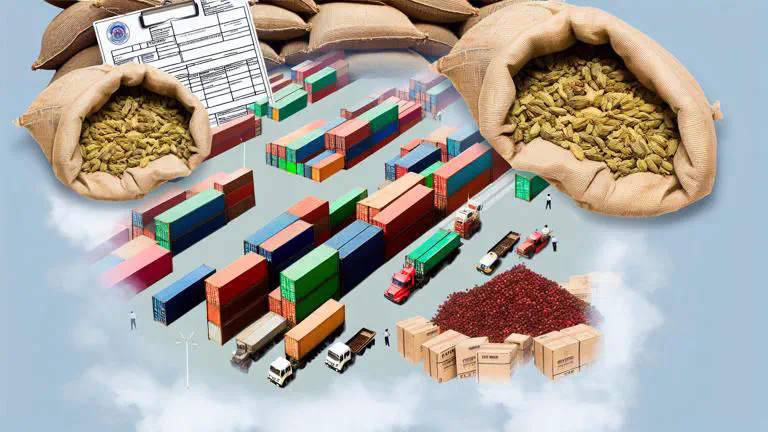
How to export cardamom from Colombia step by step
The process of exporting cardamom from Colombia requires commercial planning, compliance with phytosanitary regulations and quality assurance from the farm to the container. This practical guide is designed for exporters who want to understand, step by step, the procedures, certificates and key logistical decisions needed to bring Colombian cardamom to international markets.
Throughout the document, operational recommendations, documentary requirements and references to quality standards are integrated to help you prepare your first export or professionalise your offering.
1. Why export cardamom from Colombia? Opportunities and target markets
Colombia, as an emerging cardamom producer, can position itself in high-quality and niche segments (whole pods, organic, traceable) demanded by importers in the Middle East, the United States, Europe and Asia. Sector studies and guides show that the distribution of global trade concentrates significant shares in Gulf and Middle Eastern countries, which opens up opportunities for new suppliers offering quality and traceability.
In addition, international buyers value organoleptic and presentation characteristics (green colour, uniform size) that influence price and acceptance; markets such as the United States, the European Union and Japan require visual standards and certifications that can increase the value of the product.
2. Quick summary: steps to export cardamom from Colombia
- Carry out a diagnosis of productive and quality capacity (volumes, standards).
- Prepare basic documentation and exporter registrations.
- Ensure phytosanitary compliance and certifications required by the market (phytosanitary certificate, organic if applicable).
- Quality control and traceability of the lot (analysis, labelling, packaging in accordance with international standards).
- Define commercial terms (INCOTERMS, price, payment method) and contact buyers.
- Arrange logistics and select the port of departure and mode of transport (sea or air).
- Carry out customs clearance and dispatch of the product.
Each step is developed below with practical detail.
3. Step 1 — Commercial preparation: defining volume, quality and markets
Before starting administrative procedures, confirm:
- Supply volume per lot (kg or container), shipment frequency and the possibility of continuous supply.
- Quality standards required by your target buyer (whole pods, size, colour, moisture, residue limits).
- Certifications demanded (organic, residue analysis, quality certificates).
Remember that international buyers reward visual quality (green pods and homogeneous size) and traceability; incorporating these attributes facilitates access to higher-priced markets.
4. Step 2 — Requirements and documents to export cardamom from Colombia
The minimum documents usually requested, which must be arranged before shipment, include:
- Commercial invoice.
- Packing list.
- Phytosanitary certificate issued by the competent authority (in Colombia, the authority responsible for phytosanitary certification must be involved in the process). Compliance with phytosanitary requirements and the authorised use of agricultural inputs are key to avoiding rejections.
- Certificate of origin (when required by the buyer or the market).
- Transport documents: bill of lading (B/L) for sea freight or air waybill for air cargo.
- Special certificates requested by the buyer: organic (USDA Organic, EU Organic), residue analysis, free-sale or conformity certificates.
The preparation of sanitary and regulatory documentation for markets such as the European Union or Canada is complex and requires coordination between the exporter, the sanitary authority and the buyer; there are local experiences where documentation was managed to comply with European requirements.
5. Step 3 — Certificates and phytosanitary control
A phytosanitary certificate and compliance with authorised inputs are critical requirements for spice exports. In the Colombian and regional context, the use of agrochemicals and bioproducts must comply with the authorisations of the phytosanitary authority; in addition, organic certification schemes establish lists of permitted inputs. Ensuring safety intervals and carrying out residue analysis before shipment reduces the risk of rejection at destination.
6. Step 4 — Traceability and quality control for cardamom exported from Colombia
Implementing a batch traceability system from harvesting, drying, processing and packaging is essential. International standards and guidelines (Codex, ISO) establish physical, chemical and packaging parameters that help define product specifications (for example, moisture and ash content parameters applicable to spices). Adapting your processes to these references facilitates acceptance in foreign markets.
Practical quality control recommendations:
- Record lots by harvest date and farm of origin.
- Carry out moisture analysis and, if required by the market, pesticide residue analysis.
- Classify by visual quality (size and colour) and clearly label each lot.
- Pack in food-grade materials that protect against moisture and contamination, following packaging guidelines for spices.
7. Step 5 — Costs, prices and tax considerations
Production costs and the upkeep of the hectare are a key input for setting export prices. Local studies and guides show cost structures per hectare that must be incorporated into the calculation of the exportable price (production cost, processing, packaging, logistics and trade commissions). These guides help estimate the real cost per kilogram and define competitive margins.
Regarding tariffs and taxes, the applicable charges depend on the country of destination and the trade regime in force; therefore, you must check the tariff rate of the target market and consider international transport costs, insurance and port charges. There is no single rate: each destination applies its own specific tariffs and regulations.
8. Step 6 — Cardamom export logistics Colombia: packaging, transport and ports
Proper logistics and packaging protect quality and ensure regulatory compliance:
- Use packaging that prevents moisture ingress and allows the aroma and colour of the pods to be preserved.
- Label lots with traceability information and the documentation required by the buyer.
- Select the mode of transport based on time, cost and urgency: sea freight for large volumes and air freight for samples or urgent cargo.
- Define the port of departure and coordinate with the freight forwarder. It is essential to plan dispatch times and container bookings.
Although the choice of export port depends on logistics and the product’s point of origin in Colombia, having a freight forwarder familiar with phytosanitary and customs requirements reduces risks and waiting times. For shipments to specific markets (for example, the United States), it is advisable to coordinate with agents experienced in the route and in import requirements.
9. Step 7 — How to ship green cardamom to the United States from Colombia (case study)
Shipping green cardamom to the United States involves ensuring the quality requirements and certifications requested by the importer. General recommendations include:
- Confirming the importer’s and market’s requirements (e.g. legality of inputs, organic certifications if applicable).
- Obtaining a phytosanitary certificate and carrying out residue analysis if required by the buyer.
- Agreeing on the INCOTERM with the buyer and preparing the commercial invoice and packing list.
- Coordinating transport and customs clearance, and verifying that labelling complies with the destination market’s standards.
Buyers in the United States value visual quality and solid certifications; therefore, preparing a technical file with analyses and certifications increases buyer confidence.
10. How to find buyers of Colombian cardamom for export
Effective strategies for finding buyers:
- Contact importers and distributors specialising in spices in target markets.
- Participate in or visit international trade fairs in the food and spice sector.
- Use B2B platforms and trade directories for lists of buyers and agents.
- Establish alliances with marketing and sales companies that already supply international markets.
In the Colombian context, entrepreneurs and managers with experience have identified recurring requests from countries such as Saudi Arabia, the United States, India and Canada; establishing business relationships and quality trials with buyers in these markets can facilitate the placement of first shipments.
11. Food export standards: standards applicable to cardamom
Cardamom is marketed in accordance with quality specifications and international standards (Codex, ISO) that describe physical and chemical parameters, as well as sensory criteria. Complying with international specifications and with the importer’s specific requirements minimises the risk of rejection and facilitates access to demanding markets.
12. Final practical recommendations for exporters
- Document processes: record traceability from farm to packaging and keep analytical records per lot.
- Anticipate market requirements: ask the buyer for documentary and quality requirements before harvesting or processing the lot.
- Plan logistics: coordinate with your freight forwarder and check transit times and market seasonality.
- Ensure continuity: buyers value the ability to supply continuously and consistency in quality.
- Assess value-added certifications (organic, fair trade) if targeting premium niches.
13. Pre-shipment verification checklist (useful summary)
- Volume and lot confirmed.
- Moisture analysis and, if applicable, residue analysis carried out.
- Phytosanitary certificate arranged with the competent authority.
- Commercial documents prepared: invoice, packing list, certificate of origin.
- Packaging compliant with standards (food-grade material) and labelling with traceability.
- Transport contracted and contingencies planned for.
- Buyer confirmation regarding receipt and market entry conditions.
Conclusion
Exporting cardamom from Colombia is a promising opportunity if product quality is combined with regulatory compliance and well-planned logistics. The critical elements are: understanding and documenting the quality required by the buyer, ensuring phytosanitary and residue compliance, and coordinating efficient logistics that preserve the product’s characteristics until it reaches its destination. The technical and market references available help structure a competitive and reliable commercial offer.
Request advice to start your export.
Which market are you interested in prioritising for your first export, and what specific questions do you have about documentation or shipping logistics?
About the author
Juan Pablo Toro López is an Agro-industrial Engineer (Universidad La Gran Colombia) with more than 15 years of experience in the food production chain: production, food safety, process standardisation and export requirements. He has been an agro-industry lecturer at SENA and at universities such as Universidad Andina and Fundación Universitaria San Martín, and a digital marketing and sales consultant for companies in the sector.