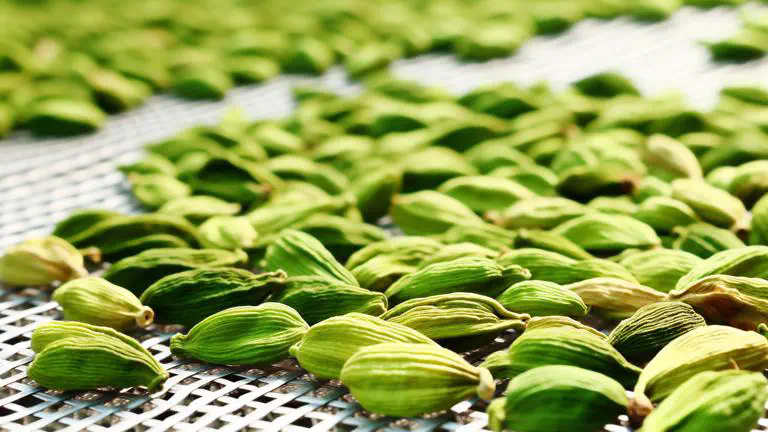
How to dry green cardamom without losing colour
Drying is the post-harvest stage that has the greatest influence on the appearance, aroma and commercial value of cardamom. For producers in Colombia seeking export quality, knowing “how to dry green cardamom” professionally is essential to maintain the green colour, pod integrity and essential oil content.
This guide, aimed at producers, presents professional drying techniques based on protocols and technical documents applicable to the cardamom sector, with practical references for drying on the farm, at collection centres and in preparation for export. Each recommendation is supported by technical sources from the available material to ensure the information is usable in the field.
Table of contents
- Importance of drying for maintaining colour and quality
- Prior preparation: harvest and immediate handling
- Selection, cleaning and sorting before drying
- Drying methods: sun vs artificial drying (advantages and limitations)
- Critical drying parameters (temperature, time, moisture)
- Drying curves and phases: practical recommendations
- Pre-treatments and techniques to preserve colour
- Equipment and design of a professional dryer
- Moisture control and inspection points
- Final quality, grading and export requirements
- Step-by-step procedure (SOP) for producers
- Common problems and practical solutions
- Summary and calls to action
Importance of drying for maintaining colour and quality
The purpose of drying is not solely to reduce moisture; it is to preserve sensory attributes (colour, aroma) and physical attributes (pod integrity) that determine price and commercial destination (local market, grinding or premium export). The highest-value green cardamom requires a drying process that minimises oxidation and the degradation of essential oils. Technical documents emphasise that quality is achieved with appropriate selection, sorting and drying equipment and with fast handling from harvest through to the start of the drying process.
Prior preparation: harvest and immediate handling
Picking and timing: Pick mature pods at the optimum point and, when the product is destined for quality or export processes, aim to bring the cardamom to the collection centre or processing area within less than 10 hours of harvest to prevent initial oxidation.
Avoid overripe or very unripe fruit: Fruit that is not at the right stage results in poor drying quality. Proper selection in the field reduces losses at later stages.
Transport: Use clean, dry and ventilated containers; avoid compaction, which could create microclimates and trigger fermentation.
Selection, cleaning and sorting before drying
Surface cleaning: Remove soil, leaves or other contaminants. Use clean water if necessary, drying and ventilating the pods before placing them in the dryer to reduce localised surface moisture.
Sorting by size and sanitary condition: Separating damaged or perforated pods prevents cross-contamination. Sorting by calibre supports an even distribution on trays or in dryers.
Intermediate packing: If there is a waiting period, store at low ambient temperature and low humidity (ventilated spaces protected from the sun) to preserve colour. At collection centres, use high-barrier polyethylene bags only if the product is in dry condition, and track the moisture level.
Drying methods: sun vs artificial drying
Sun drying
- Advantages: low capital investment.
- Risks to colour: prolonged exposure to direct sunlight and high temperatures can cause discolouration and loss of volatile oils.
- Estimated time: 30–40 hours, turning constantly to ensure even drying; for this reason, although viable, it is not the most recommended method for cardamom destined for premium markets.
Artificial (mechanical) drying
Advantages: control over temperature, time and airflow; better preservation of colour and aroma.
Technical recommendation: regulate the temperature to no more than approximately 55 °C and reach the drying point within controlled times — protocols mention around 10 hours under controlled conditions to obtain pods with good appearance and adequate moisture.
Equipment: tray, tunnel or chamber dryers with temperature control and air circulation; these allow replicability and consistency in quality.
Critical drying parameters (temperature, time, moisture)
Maximum recommended temperature: ~55 °C in artificial drying to avoid overheating that would impair colour and aroma.
Target moisture: around 9–10% after drying; some procedures envisage that, after grading and conditioning, the commercial moisture content may be left at 12–13% depending on conditioning criteria prior to transport and sale. Maintaining these ranges contributes to stability during storage and export.
Time: depends on the method and conditions; for artificial drying, protocols cite approximate periods of 10 hours under controlled conditions; in drying curves, the initial rapid-rate period may last 4–6 hours and the slow falling-rate phase several hours longer (12–18 h in the reference), implying a total drying process carried out in phases to avoid heat damage. Adjust according to initial moisture and equipment.
Drying curves and phases: practical recommendations
Ideal drying is managed in phases:
Rapid initial phase: removal of surface moisture. In studies and practical protocols this phase typically lasts 4–6 hours; maintaining a constant temperature and avoiding thermal shocks is essential.
Slow falling-rate phase: the rate of moisture loss decreases. Here, precise control of temperature and time prevents the pods from drying out excessively, preserving colour and volatile oils. In the cited protocols, the second phase may extend 12–18 hours depending on conditions and equipment.
Practical tip: monitor moisture and colour in representative samples and adjust the total time based on actual readings and sensory observation. Frequent visual inspection during the process helps correct parameters without damaging quality.
Pre-treatments and techniques to preserve colour
Sodium bicarbonate treatment: in reference protocols, a pre-treatment with 2–5% sodium bicarbonate before drying can help intensify the green colour of the pods. This treatment must be applied with care and control, testing on small batches before scaling up.
Controlled cooling after drying: after drying, allow the pods to cool to ambient temperature in a dry, ventilated environment before packaging, to avoid condensation.
Avoid prolonged direct sun exposure during and after drying to prevent discolouration caused by oxidation.
Equipment and design of a professional dryer
- Tray dryers and controlled chambers allow batch handling, temperature uniformity and airflow.
- Basic design: ventilated heat source, trays with uniform airflow, the ability to regulate temperature and time, and a moisture meter for in-line monitoring.
- Investment considerations: if the goal is to export premium cardamom, investment in controlled mechanical drying improves consistency and reduces losses from rejection or downgrading due to poor quality.
Moisture control and inspection points
- Use hygrometers or moisture meters to check progress.
- Take representative samples from top and bottom trays and measure moisture and appearance.
- Establish control points: start (0 h), rapid phase (4–6 h), intermediate (end of rapid phase), recommended end of drying (upon reaching 9–10% moisture) and post-cooling before storage.
Final quality, grading and export requirements
Grading by quality: there are commercial categories (Extra Fancy Bold, Fancy Green, Superior, Mixed Quality, Industrial Quality) that define uses and market values; each category is based on size, pod integrity, colour and aroma. These grades are used to determine commercial destinations, from premium to industrial.
Physico-chemical parameters: international standards and technical guidelines (Codex, ISO) establish limits and parameters for spices, including cardamom; for international trade it is important to know the technical specifications and ensure the product complies with the applicable parameters for ash, moisture and volatile oils.
Certification and traceability: for demanding markets, consider organic certification and ensure traceability documentation; organic certifications (USDA, EU Organic, JAS) require recording of agricultural practices and post-harvest handling in accordance with the relevant standards.
Phytosanitary requirements: before exporting, check the importing country’s requirements and inspection and residue control protocols.
How to dry green cardamom at home (small-scale producer)
If you work on a small scale or wish to trial protocols on the farm:
- Harvest and transport to the drying area in less than 10 hours where possible.
- Sort and remove unwanted material.
- For drying in a stove or small chamber: keep the temperature below 55 °C and carry out inspection cycles every 2–4 hours. Use single-layer trays for uniform airflow.
- For sun drying: place trays in partial shade with frequent turning; allow 30–40 hours and monitor to avoid overexposure.
Note: “how to dry green cardamom at home” can be useful for batches for personal consumption or trials, but to reach export standards the recommendation is to scale up to controlled drying.
How to dry green cardamom for export from Colombia and guidance for collection centres
When the product is destined for export, the process must be traceable, consistent and documented:
- Reception: record the date and time of harvest and reception; as an operational reference, harvesting and transporting within less than 10 hours helps preserve initial quality.
- Grading and sampling: separate by calibre and condition; carry out physical analyses and, where applicable, moisture tests before and after drying.
- Drying: apply controlled artificial drying with regulated temperature (no more than 55 °C) and record times and moisture readings; aim for a final moisture content close to 9–10% as a technical target.
- Conditioning: cool, sort by commercial grade and pack in appropriate barrier material to prevent moisture ingress during storage and transport.
- Documentation: keep traceability records, phytosanitary certificates and, where applicable, organic certifications or other buyer requirements.
This “green cardamom drying guide for export” is the basis for operating procedures at collection centres and processing plants in Colombia, always adapting the steps to the specific requirements of the client or importing country.
Step-by-step procedure (brief SOP) — Producers and collection centres
- Harvest and transport: pick pods at the optimum point and bring to the collection centre in less than 10 hours where possible.
- Reception and grading: remove damaged pods and separate by calibre.
- Cleaning: remove impurities; ventilate to eliminate surface moisture.
- Dryer preparation: set temperature to ≤55 °C and check airflow.
- Loading: distribute in a single layer on trays with uniform flow.
- Start of drying: control and record temperature and moisture; schedule inspections (4–6 h, 10 h, end of drying based on moisture reading).
- Cooling: allow to cool in a dry environment before packaging.
- Final grading and packaging: separate grades and pack in material suitable for transport.
- Record-keeping: retain traceability records, moisture readings and batch details.
Common problems and practical solutions
Colour degradation: check temperature and time; avoid heat spikes and prolonged direct sun exposure. Use controlled mechanical drying where possible.
Uneven drying: improve air circulation and avoid stacking; rotate trays during drying.
Post-drying condensation: allow to cool before packaging and use packaging materials that do not retain moisture; control temperature and humidity in storage areas.
Standards and requirements for exporting cardamom from Colombia
To access international markets, the following must be considered:
Technical standards and quality specifications (ISO, Codex and national regulations) that define physico-chemical parameters and purity and presentation criteria. Knowing and applying these standards facilitates international acceptance of the product.
Organic and process certifications (where applicable) requiring documentation of agricultural practices, pesticide management and traceability.
Phytosanitary and residue requirements: each importing country sets its own limits and required certificates; coordinate with local authorities and buyers to meet these requirements.
Final recommendations for producers (summary)
- Act quickly between harvest and drying: less time between picking and entry into the dryer improves colour and aroma retention.
- Prefer controlled artificial drying for products destined for premium markets; maintain temperature ≤55 °C and control final moisture at around 9–10% according to protocols in technical documents.
- Record and document: traceability and documentary control are key for export and for improving internal processes.
What’s next if I want to certify and market premium cardamom?
If your intention is to position the product in value markets, the next phase is to document processes, run batch trials, establish quality controls and, where applicable, process certifications. Investments in controlled drying and traceability tend to translate into greater market access and better prices for quality.
Learn the method to obtain premium cardamom.
What challenges does your farm or collection centre face today in applying controlled, consistent drying that preserves the green colour and maximises the value of your cardamom?
About the author
Juan Pablo Toro López is an Agro-Industrial Engineer (Universidad La Gran Colombia) with more than 15 years of experience in the food production chain: production, food safety, process standardisation and export requirements. He has taught agro-industry at SENA and at universities such as Universidad Andina and Fundación Universitaria San Martín, and has worked as a digital marketing and sales consultant for companies in the sector.