Efficient techniques for planting cardamom
Introduction
The aim of this technical guide is to offer farmers and technicians a practical reference on techniques for planting cardamom in Colombia, focusing on site selection, rhizome propagation, soil management and organic fertilisation, integrated pest control, and commercial and cost considerations. The content is aimed at producers seeking to implement professional, sustainable systems based on documented experiences and practical protocols for mother plantations and production scale-up.
1. Planning and site selection
1.1. Ecological zoning and climate
Before deciding to plant, carry out an ecological zoning of the property: identify altitude, rainfall pattern, average temperature and seasonality. Analysis of the crop’s climatic and soil requirements is essential to determine whether the site is suitable and to define management strategies adapted to the microzone. For Colombia, there is technical literature summarising zoning, climatic requirements and soil properties that should be taken into account in planning.
1.2. Access, water availability and services
Assess water availability for irrigation and management, access for farm work and transport, and the logistics for marketing and sales or export. Economic viability will depend both on agronomic suitability and on accessibility to markets and services.
2. Soils and pre-planting analysis
2.1. Soil characteristics
The crop requires well-drained soils with good structure and organic matter content; soil diagnosis (texture, pH, organic matter and nutrient availability) allows corrections and the fertilisation strategy to be defined. Studies and guides on soils and fertilisation recommend prioritising soil biological health for medium- and long-term sustainability.
2.2. Preparation and corrections
Carry out soil analysis before land preparation. Apply amendments and correctives (lime, compost and others) according to laboratory recommendations and the property’s history; avoid over-application of nitrogen fertilisers without technical diagnoses. Record all amendments and results to design an effective fertilisation plan.
3. Selection of genetic material and establishment of the mother plantation
3.1. Mother plants and genetic bank
Selecting healthy, vigorous mother plants with traceability is the foundation for successful reproduction. Establishing an organised mother bank, with records of origin, plant codes and periodic monitoring, facilitates the production of quality rhizomes and the traceability required for demanding markets. Practical protocols for designing and maintaining a mother bank are described in specialised guides.
3.2. Advantages of the mother plantation
A well-managed mother bank ensures a supply of plant material, allows the selection of elite genotypes and reduces phytosanitary risks by maintaining periodic health and nutrition checks. Keep technical records for the bank plants and update them every six months.
4. Propagation: division and planting by rhizome
4.1. Principles of rhizome multiplication
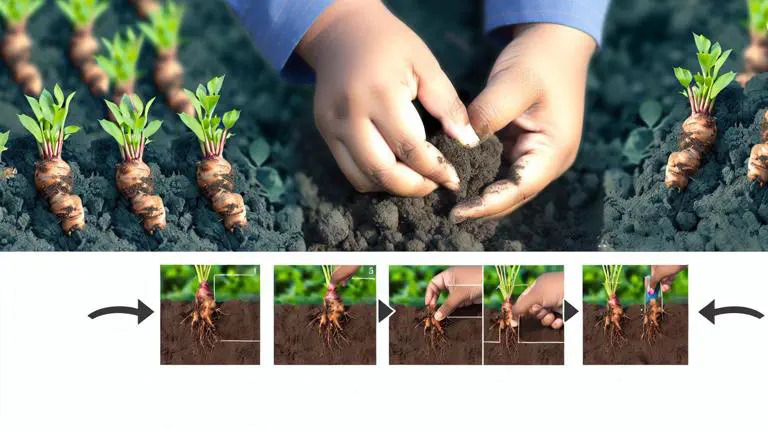
Rhizome propagation is the most widely used technique for establishing new plants with the characteristics of the mother material. Success depends on extracting rhizomes with enough buds, disinfecting tools, curing the cuts and planting under controlled shade and humidity conditions. Detailed protocols describe how to divide, treat and plant rhizomes to maximise sprouting rate.
4.2. Summary of practical steps
- Select firm rhizomes with a minimum number of active buds.
- Disinfect tools and make cuts following sanitary criteria.
- Cure the cuts in a ventilated, shaded place; avoid direct sun exposure.
- Plant without excessive delay: do not store for more than 7 days unless ideal conditions are maintained.
- Record the planting date, batch of origin and observations for monitoring.
Common mistakes and solutions (according to technical documentation): cutting rhizomes that are too small (avoid), failing to disinfect tools (prevent with iodine or disinfectants), excess water (rotting problems), and direct sun exposure (dehydration).
5. Plantation design, density and shade
5.1. Density and layout
A widely used technical density reference is planting in squares of approximately 2 x 2 m, giving around 2,000 plants per hectare; however, density can be adjusted according to production objectives and shade management. Establishment and maintenance costs per hectare are documented and should be considered in financial planning.
5.2. Shade and microclimate management
Cardamom benefits from a microclimate with protection from direct light (living shade) and stable relative humidity. Improving the microclimate through living or temporary shade reduces heat stress and favours crop health; this is part of the preventive cultural practices described in technical guides.
6. Irrigation and water management
6.1. General principle
Water must be an ally of the crop: maintaining adequate moisture without causing waterlogging is key to avoiding rot and favouring root development. Technical documentation emphasises the balance between moisture and drainage.
6.2. Systems and considerations
While technical guides recommend evaluating irrigation systems according to availability and costs, one alternative under contemporary technical discussion is drip irrigation for cardamom in Colombia, which should be evaluated through cost-benefit analysis and according to the producer’s management capacity and the property’s conditions. In the absence of standardised local protocols, the decision should be based on water analysis, topography and installation and operating costs.
7. Fertilisation and crop nutrition
7.1. Principles and approaches
Studies and experience with similar crops recommend prioritising soil biological health: applying organic fertilisers (bocashi, compost), vermicompost and efficient microorganisms helps maintain fertility and production sustainability. It is advisable to carry out soil analysis and design a nutrition programme that combines organic amendments and, where applicable, balanced fertilisation based on diagnosis.
7.2. Practical examples and organic management
Mother plantation and maintenance protocols record the use of liquid compost, Trichoderma and worm leachate as nutrition and disease-control practices in organic systems, with periodic application calendars adapted to the condition of the plot. Keeping application records facilitates adjustments and future certifications.
8. Integrated pest and disease management
8.1. General approach
Integrated pest management (IPM) combines cultural practices, sampling, biological controls and, when necessary, selective chemical tools. Prevention through plant material health and keeping the plot clean (removal of crop residues, sanitary pruning) is essential to reduce inoculum and pest and disease populations.
8.2. Thrips and recommended strategies
Among the significant pests, thrips can affect pods and flowers; technical documents cover biological and botanical options (neem, vegetable oils, potassium soaps, botanical pyrethrins, spinosad for organic programmes) that have shown efficacy in trials and integrated management recommendations. These alternatives help reduce residues in the product and sustain access to markets with low-residue requirements.
8.3. Fungal control and cultural measures
For fungal diseases, preventive management is recommended: pruning of damaged parts, plot cleaning, controlled burning or removal of crop residues, and applications of products at technical dosages when diagnosis indicates. Periodic pruning and moisture control in the basal layer help minimise fungal proliferation.
9. Planting and harvest calendar (practical reference)
To facilitate the scheduling of tasks, a simplified guide of annual activities (based on experience and protocols) proposes actions by month, from soil preparation and rhizome planting to checks and results analysis. This calendar serves as a reference for designing the Colombian cardamom planting and harvest calendar on each farm, always adapting it to local conditions. Simplified example:
- Jan–Feb: soil preparation and diagnosis.
- Mar–Apr: rhizome planting / transplanting.
- May–Jun: weed management and biofertiliser applications.
- Jul–Aug: vigour and health assessment.
- Sep–Oct: shade and compost reinforcement.
- Nov–Dec: results analysis and expansion planning. These stages should be adjusted to the microclimate and rainfall regime of the production area.
10. Establishment costs and economic estimation
10.1. Cost components
Technical cost documents include line items for land preparation, soil analysis, inputs (compost, microorganisms, tools), maintenance work days, and harvest and processing activities. Documented cost sheets per hectare provide a basis for calculating initial investment and maintenance costs. Refer to the cost guide to prepare your budget and financial plan before establishing the plantation.
10.2. Time horizon and harvest point
Economic returns depend on establishment time, productivity per plant and product quality. Technical documentation indicates that harvesting and processing can begin around 18 to 24 months after planting, depending on management and local conditions; plan cash flows based on these timeframes and yield projections.
11. Marketing, sales, markets and export considerations
11.1. Potential markets and quality standards
Cardamom is traded internationally according to purity and quality specifications; the harmonisation of international standards (Codex, ISO) facilitates trade and defines technical and product safety criteria. Accessing demanding markets requires meeting quality and traceability specifications.
11.2. Export: general steps and requirements
For those considering international sales (for example, steps to export cardamom from Colombia to the United States or export routes for cardamom from Colombia to Latin America), it is essential to obtain information on sanitary and phytosanitary requirements; technical documentation recommends working with competent authorities and foreign trade advisors to meet the necessary requirements and certifications. Avoid assuming requirements without technical and legal advice.
12. Best practices and final recommendations
- Establish and maintain a mother bank with records of origin, health and productivity.
- Carry out soil analysis and design a fertilisation plan that prioritises organic amendments and soil longevity.
- Implement integrated pest management focused on prevention, sampling and the responsible use of bio-inputs and products approved under your production scheme.
- Record costs (installation and maintenance) and project cash flows to assess profitability per hectare.
- Design an operational calendar adapted to the local climate and keep technical records of all tasks and applications.
Conclusion
Cardamom planting techniques that integrate material selection, rhizome propagation, soil management with an emphasis on organic matter, integrated pest control and economic planning are the basis for establishing sustainable, market-oriented production systems. The protocols described in technical guides offer practical steps and records that reduce risk and increase the capacity to scale up production while maintaining quality and traceability.
Master professional planting techniques.
Which technical aspect (material selection, rhizome management, nutrition or pest control) do you consider a priority for optimising your next cardamom planting, and why?
About the author
Juan Pablo Toro López is an Agro-Industrial Engineer (Universidad La Gran Colombia) with more than 15 years of experience in the food production chain: production, food safety, process standardisation and export requirements. He has taught agro-industry at SENA and at universities such as Universidad Andina and Fundación Universitaria San Martín, and has worked as a digital marketing and sales advisor for companies in the sector.