Introduction
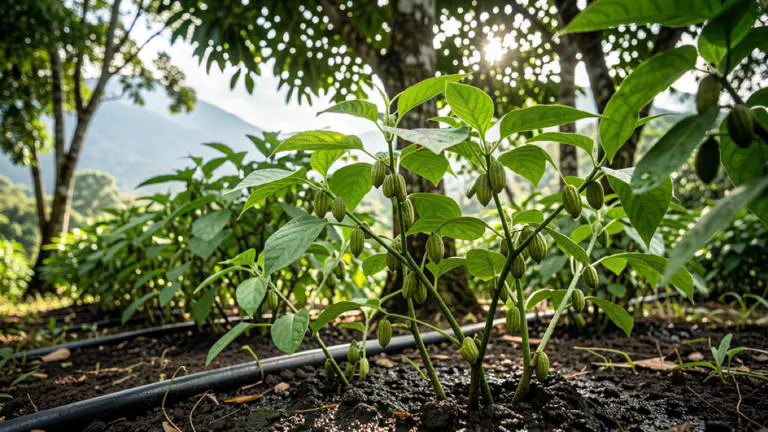
Cardamom is one of the most water-demanding crops in Colombia, and this has nothing to do with the amount of rainfall it receives, but rather with three factors that rarely coincide in the field: a shallow root system, evergreen foliage that transpires year-round, and a narrow reproductive window that is lost entirely if the plant dries out.
In the producing regions —Antioquia, Risaralda, Quindío, Caldas, Huila and Tolima— annual rainfall ranges from around 1,400 to 2,600 mm, but this rain is concentrated in just a few months. Between cycles, the crop depends entirely on irrigation. A large part of the production losses attributed to “poor flowering” actually stem from poor water management.
Note on the figures: the values in this article are reference technical ranges. Each plot has its own combination of soil, altitude and microclimate. Use them as a starting point and validate with a technician in your area.
Why cardamom dries out so easily
Before discussing frequencies it is worth understanding the mechanism, because it explains why irrigating cardamom is not like irrigating coffee or cocoa.
1. Shallow root system
Unlike coffee, whose roots descend more than 60 centimetres, cardamom roots are concentrated in the first 20 to 30 centimetres of soil, with a high density of fine roots. This has two consequences:
- They cannot explore deep water. If the first 20 centimetres dry out, the plant enters water stress even if the soil profile below holds moisture.
- They do not tolerate saturation. In the same zone where they need it, roots suffocate if water does not drain away. Cardamom needs high moisture and high drainage at the same time.
2. Constant transpiration
The plant does not enter a water-related dormancy as occurs with several temperate-climate species. The evergreen leaves continue transpiring throughout the year. In an environment with low relative humidity and high radiation —a common situation in the Coffee Belt (Eje Cafetero) between December and March— water loss is considerable, and that demand can only be met through irrigation.
3. Flowering is the critical point
Flower buds form at a stage when the plant is especially sensitive to water deficit. When soil moisture drops during inflorescence development, two things happen:
- Floral abortion. The plant stops investing in buds and those already formed dry out.
- Fewer viable fruits per tiller, which is the factor that most directly determines yield.
The most costly mistake a grower can make is not underwatering during vegetative growth, but irregular watering during flowering.
Irrigation frequency by stage
The table below organises the recommendation. The lower range applies to clay soils with good retention capacity; the upper range applies to sandy or loamy soils on slopes with high percolation.
| Stage | Timing | Suggested frequency | Range (mm/day) | Observation |
|---|---|---|---|---|
| Germination | Freshly planted seeds and rhizomes | 1 to 2 days | 3-5 | The substrate must remain moist; watch out for waterlogging |
| Vegetative | Up to 6-8 months | 5 to 7 days | 4-6 | Active growth, moderate demand |
| Flowering | Months 10-12, variable by zone | 2 to 3 days | 5-8 | Critical stage. Stress here reduces fruit set |
| Fruit filling | 3 to 4 months after flowering | 2 to 3 days | 5-7 | Determines the final weight of the pod |
| Post-harvest | After picking | 7 to 10 days | 2-3 | Maintains foliage and the planting’s reserves |
| Recovery | After the harvest flush | 7 to 10 days | 2-3 | In high-altitude zones, protect against frost with occasional night-time irrigation |
How to read the table: millimetres per day are a reference for water demand. To convert them into a frequency you need to know your soil’s available water, explained below.
Calculating water: from millimetres per day to litres per plant
Step 1 — Root depth
For an established, mature planting use 20 centimetres. For seedlings or container-grown crops, 10 to 15 centimetres.
Step 2 — Your soil’s available water
Determine the texture in the field. A quick test: moisten a handful of soil and try to form a ball. If it holds together without crumbling, you have clay soil; if it breaks apart quickly, sandy soil.
| Soil texture | Available water (mm per 10 cm) | Approximate retention |
|---|---|---|
| Sandy | 5 to 8 mm | Low |
| Loamy | 12 to 16 mm | Medium |
| Clay loam | 18 to 22 mm | High |
| Clay | 22 to 28 mm | Very high, with risk of waterlogging |
Step 3 — Estimated daily consumption
For mature cardamom in vegetative growth, the reference demand is 4 to 6 mm/day. During flowering it rises to 5 to 8 mm/day. These values assume the foliage covers the soil well; in young plantings with little shade there is less transpiration, but also more direct evaporation.
Step 4 — Litres per plant
As an operational reference for a mature plant in clay loam soil, with 20 centimetres of root depth and a canopy cover of around 60 centimetres:
- Consumption during flowering: 6 mm/day
- Root depth: 20 cm
- Result: 4 to 6 litres per plant during vegetative growth, and 6 to 9 litres during flowering.
For container-grown crops, which is a completely different system, the calculation is done by substrate volume:
Irrigation volume = 25% to 35% of the substrate volume
That is, in a 10-litre pot with well-draining substrate, water with 2 to 3 litres when the top 2 to 3 centimetre layer feels dry to the touch.
Timing of irrigation: not just how much, but when
Maintenance irrigation versus critical irrigation
- Maintenance. Sustains growth. Moderate frequency; a one-day delay can be tolerated.
- Critical. Flowering and fruit filling. These cannot be skipped. If a cycle is missed, make up the volume the following day.
Signs that irrigation is needed
- Touch. Insert a finger 3 to 4 centimetres. If it comes out dry at that depth, water.
- Leaf turgor. Leaves lose their shine and become slightly limp before showing permanent damage.
- Foliage colour. Excessively dark green indicates excess moisture; greyish or yellowish green indicates deficit.
- Soil colour. Soil that is barely moist on the surface needs irrigation; soil that is soaked and stays waterlogged needs drainage, not more water.
Avoid the hottest hours
Water early in the morning, ideally between 5 and 8 a.m., or late in the afternoon. Irrigating during the hottest hours of the day loses more water to evaporation, can cause thermal stress at the root, and reduces water use efficiency.
The exception is occasional night-time irrigation against frost in high-altitude zones, applied in small volumes and only when the event is forecast.
How to prevent the drying-out that destroys flowering
These practices go beyond “watering often” and are what separate a planting that produces consistently from one that is unpredictable year after year.
1. Soil cover (mulch)
This is the highest-return practice in zones with seasonal water deficit. The most commonly used options in Colombia:
- Coffee pulp, an abundant by-product of the farm in the Coffee Belt. It adds organic matter and regulates the soil’s microclimate.
- Sugarcane bagasse or maize stubble, common in Urabá and Tolima.
- Dried cardamom leaves, generated by the crop itself.
The layer should be 5 to 8 centimetres deep and leave the plant’s collar uncovered to prevent rot.
2. Regulated shade
Cardamom needs between 25 and 30% shade in high-altitude areas of the Coffee Belt, and up to 40 to 50% in lower, warmer zones such as Tolima or Magdalena Medio. Shade reduces transpiration and thermal stress. The usual systems:
- Cocoa or plantain in interspersed rows.
- Guamo (Inga edulis), the most recommended option for its nitrogen fixation and fast growth.
- Native trees of the area along boundaries and edges.
3. Efficient irrigation system
| System | Coverage | Cost | Comment |
|---|---|---|---|
| Furrow irrigation | Flat areas only | Low | Risk of erosion on slopes |
| Micro-sprinkler | Entire planting | Medium | Recommended. Delivers water at the base and wets little foliage |
| Drip | Entire planting | High | Efficient, but prone to clogging from particles |
On slopes, where most of Colombia’s cardamom crop is grown, micro-sprinkler or drip irrigation make the difference between stable and unpredictable production.
4. Measure instead of estimate
For those who want to measure rather than guess, a ceramic-bulb tensiometer directly confirms water availability in the root zone. With it you can define the exact frequency for your soil and climate, detect the point of drying-out before the plant shows it, and distinguish whether the problem is one of frequency or volume.
Most common mistakes
| Mistake | Consequence | How to correct it |
|---|---|---|
| Watering only by calendar without observing the soil | Dehydration during drought peaks, waterlogging during rains | Supplement the calendar with a weekly tactile check |
| Watering the foliage instead of the base | Fungal infections and high evaporation | Direct the micro-sprinkler towards the plant’s crown |
| Confusing waterlogging with good irrigation | Rhizome rot and plant death | Improve drainage before increasing frequency |
| Suspending irrigation during flowering due to apparent rain | Rain does not always meet demand | Use forecasts and soil moisture as a reference |
| Planting in soil with a shallow water table | Permanent root asphyxiation and yellow plants | Check the plot’s depth and drainage before planting |
| Not using cover (mulch) | High evaporation and soil temperature | Apply 5 to 8 cm of organic material |
Operational summary
- Water towards the base of the plant, not over the leaves.
- Reference frequency: every 5 to 7 days during vegetative growth; every 2 to 3 days during flowering and filling.
- Reference volume: 4 to 6 litres per mature plant in clay loam soil, adjusted for texture.
- Water early in the morning; avoid midday.
- Define your frequency by soil texture, not only by climate.
- During flowering and filling, not a single cycle can be skipped. This is the stage where water determines yield.
- Use 5 to 8 cm of cover and 25 to 50% shade. These are the two practices that most reduce irrigation demand.
- Measure if you can. A tensiometer or a weekly tactile check will save you from both excess and deficit alike.
About the author
Juan Pablo Toro López is an Agro-industrial Engineer (Universidad La Gran Colombia) with more than 15 years of experience in the food production chain: production, food safety, process standardisation and export requirements. He has taught agro-industry at SENA and at universities such as Universidad Andina and Fundación Universitaria San Martín, and has advised companies in the sector on digital marketing and sales.
About Cardamomo Colombia
We are producers and exporters of Colombian cardamom. If you are looking for quality seed or rhizome for your nursery, farm-gate purchase price information, or agronomic management advice for your plot, visit our contact page or write to us directly.
Sources and recommended reading
To go further than this article:
- Cardamom Cultivation Manual (ICA, Instituto Colombiano Agropecuario), an institutional reference for agronomic management in Colombia.
- Publications by Universidad Nacional and CEPRO on research in the Coffee Belt.
- Technical material from ICTA-CRIA (Guatemala) on water resource management in cardamom.
- FAO guides on irrigation requirements for export crops.
The figures for millimetres per day and litres per plant are reference technical ranges, not guaranteed values. For a specific production outcome, validate with a technician in your area and consider instrumenting soil moisture.
Keep reading
- How to germinate cardamom seed: step by step and how long it takes
- Essential care for cardamom cultivation
- How to plant cardamom in Colombia: a practical guide