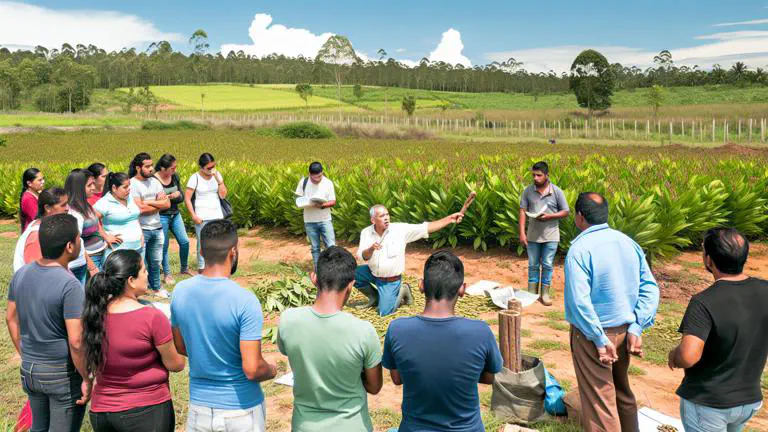
Training in cardamom cultivation in Colombia
The cardamom sector in Colombia is growing, and with it the demand for technical and practical training aimed at producers and students. This article presents the educational options available, the key content that training programmes should include, and recommendations for choosing courses that add real value to cardamom production, marketing and sales, and export. Throughout the text, practical aspects are included based on guides and studies on mother plantations, sanitary management, certifications and markets relevant to Colombia.
Why training is strategic for producers and students
Training in cardamom cultivation in Colombia enables producers to improve product quality, increase production efficiency and access higher-value markets. Well-designed training programmes help build understanding of crop cycles, mother plantation establishment, sanitary management, traceability for certifications, and the logic of marketing and sales and export. In contexts where production is still nascent, training also facilitates the adoption of practices geared towards special markets, such as organic and premium markets.
Target audience and training needs
- Producers (small and medium-scale) seeking to improve yield, quality and access to domestic and international markets.
- Students of agronomy, agro-industry and related fields interested in specialising in a value chain with export potential.
The most common training needs are: management of mother plantations and rhizome multiplication; sanitary management and pest control; good harvest and post-harvest practices; traceability and certification requirements; and marketing and logistics aspects for export. Technical material is available on these topics and should be incorporated into courses.
Types of programmes and training modalities
- Farmer field schools (FFS)
- Format: practical activities on the farm, with exchange among producers and visits to demonstration plots.
- Advantage: direct learning under real conditions; possibility of replicating techniques on one’s own farm. Farmer field schools foster learning between farms and collaborative problem-solving.
- In-person practical courses (intensive workshops)
- Format: theoretical-practical sessions of 2 to 7 days, with hands-on practice in establishing mother plantations, rhizome division, sanitary control and record-keeping.
- Typical content: land diagnosis, mother bank design, propagation and management techniques, bio-inputs and pest control, record-keeping and data digitalisation.
- Certified programmes and diplomas (universities and technical institutes)
- Format: academically endorsed courses for students and technicians, integrating technical and business modules.
- Advantage: may include access to research projects and links with marketing and sales chains.
- Virtual and blended training
- Format: online theoretical content complemented by practical field sessions or technical tutoring.
- Recommendation: include downloadable guides, technical data sheets and practical videos to reinforce field learning.
- Training through associativity and cooperatives
- Format: programmes run by producer associations that enable collective certifications and joint input purchasing.
- Benefit: cost reduction, greater market access and the possibility of group certification.
Key content that a cardamom training course in Colombia should include
An effective curriculum design for a cardamom training course in Colombia (aimed at producers or students) should address, at a minimum, the following modules:
- Introduction to the crop and its value chain
- Global and regional overview of cardamom: main producers and markets. Trade data and market trends help define production and commercial objectives.
- Establishment of mother plantations and vegetative multiplication
- Land diagnosis, mother bank design, selection of mother plants and establishment phases (diagnosis, selection, establishment, care and propagation). Many practical guides describe a phase-by-phase roadmap that facilitates annual and long-term planning.
- Sanitary management and control of relevant pests
- Cultural techniques, use of bio-inputs, biological control and considerations regarding chemical products, with a focus on minimising residues for export markets. In Colombia, where production tends to be oriented towards special markets, control of thrips and other pests relies on cultural techniques and bio-inputs approved for organic production.
- Good harvest, post-harvest and quality practices
- Optimal harvest timing, drying and handling to preserve colour, aroma and pod quality; the importance of drying facilities and traceability for accessing premium markets.
- Certifications and regulatory compliance
- Types of certification (USDA/EU Organic, Rainforest Alliance, Fair Trade and local certifications), main requirements and how to integrate traceability from the mother bank onwards to facilitate audits. Courses should teach producers to keep records from the first year, which facilitates subsequent certification processes.
- Marketing and sales, prices and markets
- Understanding the cardamom market in Colombia and the region, factors affecting price (colour, size, certifications) and strategies for adding value (processing, premium packaging). International commercial and price information is relevant for defining sales channels.
- Export requirements and logistics
- Current export regulations, required documentation, agrochemical residue management, packaging, traceability and the supply chain from farm to port. Understanding logistics and the supply chain is key to reducing rejections and meeting destination market requirements.
- Business management and finance for producers
- Cost calculation, profitability projections, business model design and associativity options for accessing financing and markets. Digital record-keeping practices and indicator management are indispensable tools.
Examples of practical activities that strengthen training
- Mother plantation establishment workshops with diagnostic exercises and plot design.
- Rhizome division, curing and multiplication practice, with record sheets per mother plant.
- Pest identification and integrated management sessions (including thrips management and the use of approved bio-inputs).
- Traceability simulations and preparation of documentation for certification and export.
- Visits to certified farms and drying centres to observe good post-harvest practices.
Relevant certifications and how they are addressed in training
Courses should explain the main certification schemes and their practical requirements:
- Organic (USDA, EU): requirements for non-use of prohibited agrochemicals, traceability and conversion periods.
- Rainforest Alliance and Fair Trade: criteria regarding conservation, shade management and labour conditions.
- Local certifications and sanitary registrations: the importance of keeping records from the outset to facilitate audits.
Training should teach how to plan the implementation of these certifications in order to maximise access to higher-price markets.
Requirements and regulations for exporting cardamom from Colombia
Courses oriented towards export should address documentary and sanitary requirements, as well as the residue tolerances demanded by destination markets. It is essential that producers understand that any treatment must be authorised by national authorities, and that residue management and pre-harvest intervals are critical to avoiding rejections at the border. Technical literature points to the need to combine cultural practices with approved inputs to maintain residue levels compatible with international standards.
Logistics and supply chain for cardamom from Colombia
Logistics from the farm to the customer involve: post-harvest handling (proper drying), packaging, storage and transport under conditions that preserve quality and aroma. Training programmes should incorporate practical modules on drying facilities and packaging requirements for demanding markets, as well as supply chain planning to minimise the time between harvest and processing. Proper logistics reduces quality losses and improves access to international markets.
Prices and markets: what courses should teach about marketing and sales
Courses should include analysis of cardamom prices and markets in Latin America and worldwide, including demand outlooks, factors determining price (visual quality, size, aroma, certifications) and main export destinations. Trade studies show that the main importers and international prices vary by quality and certification; therefore, training should teach how to position the product and negotiate with buyers.
How to choose a suitable course or programme
- Review the curriculum content: it should cover everything from mother plantation establishment through to marketing, sales and export.
- Look for practical evidence: prefer courses with field sessions and applied activities.
- Verify instructors’ experience and links with the value chain: universities, exporting companies or producer associations add value.
- Check whether the course offers post-course technical follow-up: advisory support for on-farm implementation and access to technical material.
Recommended training programmes according to objectives (indicative)
Objective: establish a mother plantation and multiply material.
- Programme: intensive practical workshop on mother banks, multiplication and record-keeping. Content based on practical guides describing phases from diagnosis through to propagation.
Objective: access to organic markets and certifications.
- Programme: modular course combining good agricultural practices, traceability and audit preparation. Should include training in bio-input management and residue control.
Objective: marketing, sales and export.
- Programme: diploma in value chain, logistics and international negotiation. Should include price analysis and contacts with international buyers.
Examples of practical content drawn from technical guides
- Phase 1 (Month 1–2): Land assessment (soil, shade, drainage and altitude) and water analysis.
- Phase 2 (Month 3–4): Selection of mother plants and mother bank design; soil preparation with compost and organic mulch.
- Phase 3 (Month 5–6): Installation of shade (50–60% mesh suggested in practical guides), rhizome planting and batch record-keeping.
- Phase 4 (Month 6–18): Maintaining moisture without waterlogging, application of bio-ferments and organic fertilisers, sanitary pruning and manual weed control.
This practical content is an example of what a producer should learn in a course focused on technical and field-based aspects.
Incorporating innovation and digitalisation into training
Digitalisation of records (mother plant sheets, harvest dates, treatments applied) and the use of accessible tools (spreadsheets, basic apps) facilitate traceability and access to certifications; these topics should be included in courses so that producers can turn their data into agricultural intelligence.
Final considerations for course designers and training managers
- Combine theoretical training with field practice and technical follow-up.
- Integrate modules on market, certification and logistics so that producers can make informed commercial decisions.
- Promote associativity to facilitate joint purchasing, collective certifications and more efficient marketing and sales chains.
Resources and recommended reading (to include in programmes)
Courses should be based on technical sources and practical guides on mother plantations and sanitary management, as well as on commercial studies and international standards governing cardamom quality. Incorporating case studies and pest management guides supports practical teaching.
Conclusion
Training in cardamom cultivation in Colombia is a strategic investment for producers and students seeking to add value, ensure quality and access domestic and international markets. The most effective programmes combine theory and practice, cover topics from mother plantations through to export, and teach how to keep records that facilitate certification. In a sector with growing interest in special markets, training focused on good practices, sanitary management with bio-inputs and traceability is essential for competing on quality.
Sign up for our specialised courses.
Which aspect of cardamom cultivation or marketing and sales are you most interested in exploring further for your farm or educational project?
About the author
Juan Pablo Toro López is an Agro-industrial Engineer (Universidad La Gran Colombia) with more than 15 years of experience in the food production chain: production, food safety, process standardisation and export requirements. He has taught agro-industry at SENA and at universities such as Universidad Andina and Fundación Universitaria San Martín, and has worked as a digital marketing and sales advisor for companies in the sector.