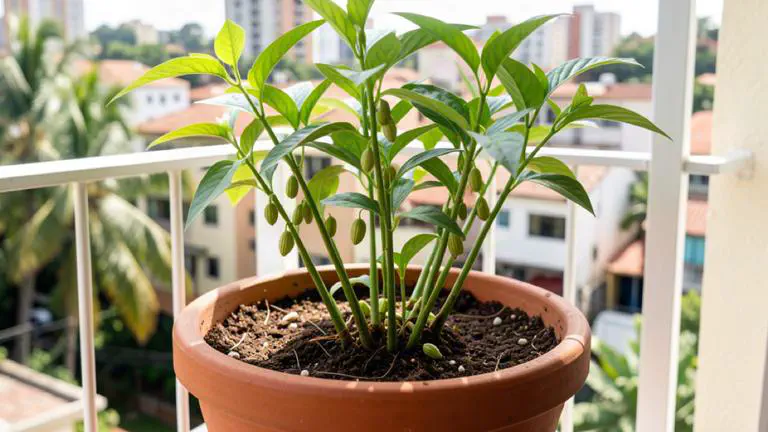
The truth first
If you’re looking for an article that tells you cardamom is an easy apartment plant, this isn’t that article.
Cardamom is a tropical understorey plant. In its natural habitat in the Coffee Region (Eje Cafetero), it grows beneath a tree canopy, with high humidity, stable temperature and partial shade. That’s not what it finds in an air-conditioned living room with fluorescent light.
That said, it can be grown at home and it’s an attractive plant for its foliage. You just need to align your expectations:
| What you can do | What you can’t do |
|---|---|
| Germinate and keep a plant alive 3-5 years | Get a harvest at home |
| A metre-tall plant in a large pot | Edible fruit before 3 years |
| Decorative, aromatic foliage | Commercial production indoors |
| A real educational project | Fast growth |
The most common mistake isn’t a failed attempt. It’s buying an adult nursery plant expecting fresh pods in six months. If you buy a plant that already has 1.5-2 years of field growth, it may produce some fruit in its first year at home. If you plant from seed today, there will be no fruit before 3 years, and probably none at all.
What to buy and where to start
Option A: buy a nursery plant (recommended)
This is the most realistic route to getting a result.
- Look for a plant 30-60 cm tall with 4 or more leaves and an already developed root system.
- Check that the substrate is moist but not waterlogged, and that the root isn’t coming out through the drainage holes (root-bound in pot = transplant).
- Ideal: a producer from the Coffee Region or a local nursery. Ask whether the plant comes from rhizome or seed: the rhizome one produces faster.
- Avoid export nursery plants, which come with inert substrate and confined in very small pots.
Option B: sow from seed
It works but is slow and has a low germination rate.
- You need the specific germination protocol: sterile substrate, temperature of 25-30 °C and constant humidity.
- In an apartment, room temperature is usually below that range.
- Check the full germination guide we wrote.
Option C: rhizome
It’s the fastest of the three.
- A healthy rhizome fragment, 5-10 cm, with a visible sprout, in moist substrate.
- It sprouts in 2-4 weeks if the environment is suitable.
The substrate: where half the result is at stake
Cardamom roots need constant moisture and air at the same time. That combination is narrow: too much air and it dries out, too much moisture and it drowns.
The mix that works
| Component | Proportion | Why |
|---|---|---|
| Coir or coconut fibre | 50% | Retains water without compacting, forms the base of the substrate |
| Perlite or vermiculite | 30% | Aeration and drainage, prevents the coir from collapsing |
| Sterile potting substrate | 20% | Structure and base nutrients |
| Compost | Optional, maximum 5% | Macronutrients; more than this compacts and damages |
Avoid: pure garden soil, coconut fibre alone (it compacts a lot), or pure perlite (it dries out too fast).
The pot
- Material: terracotta or plastic with good drainage. Terracotta lets the root breathe, which is exactly what it needs.
- Size: for an adult plant, a minimum of 40-50 litres. In small pots the plant stalls.
- Drainage: holes in the bottom, without a saucer that collects water, or with a saucer that is emptied after each watering.
- Elevation: 2-3 cm under the pot (feet or risers), so water drains and the roots don’t rot.
Light: the factor that kills this plant indoors the most
How much light
Cardamom wants 4 to 6 hours of gentle light a day. It’s a partial-shade plant.
| Location | Result |
|---|---|
| Window with sun filtered through a thin curtain | Ideal |
| Window with direct morning sun | Acceptable |
| Window with direct afternoon sun | Leaf scorch |
| Indoors 2 m from a window | Grows slowly, stretches towards the light |
| Room with no window | Survives for a short time on artificial light |
If your plant is stretching towards the light, it’s lacking light. That’s a clear sign: the stems elongate and it becomes fragile.
Direct sun
Avoid direct afternoon sun at a window. It scorches the leaves and dries out the substrate so fast that the plant doesn’t recover. Morning sun is less aggressive and is acceptable.
If your apartment is very dark
Supplement with 20-30 W LED grow light, 25-35 cm above the plant, 12-14 hours a day. This doesn’t replace sunlight, but it prevents etiolation.
Watering: the difference between living and dying
Mistake #1 is overwatering, and #2 is leaving it waterlogged.
The rule
Water when the top 2-3 cm of substrate feel dry to the touch. Not by calendar: by touch.
- In cool climates, every 7-10 days.
- In warm climates or summer, every 3-5 days.
- In winter with heating, more often, because dry air dries out the substrate.
How to water properly
- Remove the pot from the saucer if it has one.
- Water slowly until water comes out of the drainage holes. Apply in two or three rounds, not all at once.
- Wait 5-10 minutes for it to drain.
- Empty the saucer. This isn’t optional. Stagnant water in the saucer is the most common cause of root rot.
- Don’t water the leaves, especially if humidity is high. Wet leaves without ventilation develop fungus.
The humidity it actually needs
Cardamom comes from a humid environment. In a dry apartment it will struggle. Options:
- A tray with water and stones (pebble tray for evaporation) around the pot, without the base touching the water.
- Evaporation watering on the balcony floor: or dampen the surrounding floor, not the plant directly.
- Grouping plants to create a microclimate.
- A hygrometer in the room: the ideal is 60-70%. If it’s below 50%, mist the foliage with a spray bottle.
Fertilising: little and in moderation
The pot exhausts nutrients in 2-3 months. The plant needs feeding, but excess burns it.
During growth (spring-summer)
- Balanced liquid fertiliser (NPK 10-10-10 or similar) at 1/4 of the recommended concentration, every 3-4 weeks.
- Foliar feed, very diluted, once a month as a supplement.
- Compost or humus on the surface, 1-2 tablespoons, twice a year.
During dormancy (autumn-winter)
- Stop fertilising. The plant is dormant and doesn’t need it. Fertilising it in winter forces it to grow without reserves.
Signs of excess
- Brown, dry leaf tips.
- Small, deformed new leaves.
- Soil with a white crust (salts).
If you see this, stop fertilising and flush the substrate thoroughly with water.
Transplanting: when and how
When to transplant
- The plant already fills the pot: roots coming out of the drainage holes or no room left to water.
- Every 18-24 months, always in spring.
- If you notice the plant drying out too quickly, it’s a sign it needs more volume.
How to transplant
- Remove the plant carefully, holding it by the stem, never by the leaves.
- Remove 30-50% of the old substrate, loosening the tangled roots.
- Check the roots: healthy ones are white or cream-coloured and firm. Brown and soft = rot, trim them.
- New pot one size larger (4-8 cm more in diameter). Not too large: an overly large pot retains too much moisture and causes waterlogging.
- Fresh substrate around the root ball.
- Water thoroughly and don’t fertilise for 3-4 weeks after transplanting.
Common pests and problems
Yellow leaves
Causes, in order of likelihood:
- Overwatering. The most common case. Let the substrate dry between waterings.
- Lack of light. Move to brighter indirect light.
- Excessive fertilising. Stop and flush the substrate.
- Poor drainage. Check that the drainage holes are clear.
Brown leaf tips
- Dry air. Use a hygrometer and mist.
- Salt build-up. Flush the substrate and let it drain well.
- Excess fertilising.
Dark spots or black spots
- Fungus from wet foliage and poor ventilation.
- Direct afternoon sun.
Stem stretching and thinning
Lack of light. Move it closer to a brighter window or install a grow light.
Weak, pale-coloured plants
- Depleted nutrients: fertilise gently.
- Degraded substrate: transplant with fresh substrate.
Annual cycle at home
| Season | What to do |
|---|---|
| Spring | Transplanting, start fertilising, more light. It’s the best time for a pot change |
| Summer | Frequent watering, high humidity, fertilising every 3-4 weeks. Watch for waterlogging |
| Autumn | Reduce fertilising, start cutting back watering, note that yellowing leaves are normal |
| Winter | Stop fertilising, keep the substrate barely moist, move closer to the window for more light |
When should I expect fruit?
| If you planted… | First fruit expected |
|---|---|
| Seed | 3 years, and there may be none indoors |
| Rhizome | 18-24 months, if conditions are good |
| Adult nursery plant | 6-12 months in its first year at home |
The requirements for it to reach fruiting are more demanding than they seem:
- Real partial shade. Not a dark house.
- Warm months (22-30 °C) for flowering.
- High humidity. In a dry environment, it won’t set fruit.
- Stability. Frequent relocation stresses it.
- Time. After 3 years without fruit, review the whole environment.
If you’re growing for fruit, the honest recommendation is: cardamom is a field crop, not an apartment crop. Growing it in a pot is for preserving plants or enjoying the foliage.
Operational summary
- Align expectations: in a pot you produce an ornamental plant, not a harvest.
- Buy a 30-60 cm nursery plant for a result; sowing seed means waiting 3 years.
- Substrate 50/30/20: coir, perlite, commercial substrate. Never pure garden soil.
- Pot of 40-50 L minimum, with drainage, raised on feet.
- Bright indirect light, 4-6 hours. Never direct afternoon sun.
- Water when the top 2-3 cm are dry. Always empty the saucer.
- Fertilise at 1/4 dose during growth, stop in winter.
- If you see yellow leaves, the first thing to check is watering, not fertilising.
- Transplant every 18-24 months, one pot size larger, without fertilising for 3 weeks afterwards.
- For real fruit: field, not apartment. The pot is ornamental.
About the author
Juan Pablo Toro López is an Agro-industrial Engineer (Universidad La Gran Colombia) with more than 15 years of experience in the food production chain: production, safety, process standardisation and export requirements. He has been an agro-industry lecturer at SENA and at universities such as Universidad Andina and Fundación Universitaria San Martín, and a digital marketing and sales advisor for companies in the sector. See the author’s full profile.
About Cardamomo Colombia
We are producers and exporters of Colombian cardamom. If you’re looking for quality seed or rhizome, or information on purchase prices paid to the producer, write to us through the contact form.
Sources and recommended reading
- Cardamom cultivation manual (ICA) — institutional reference for Colombia.
- Guides from Universidad Nacional and CEPRO on cultivation in the Coffee Region.
- ICTA-CRIA (Guatemala) documentation on cultivation and shade management.
The substrate proportions, watering frequencies and fertilising windows are technical references adjusted for pot cultivation. The actual outcome depends on your climate, the city’s humidity, pot size and variety. For a crop you aim to produce, the recommendation remains the field.